
Drainage guide
Yard drainage problems and how they are fixed in Charlotte, NC
Most wet yards have a simple cause. The trick is finding where the water comes from and where it has nowhere to go.


Why Charlotte yards hold water
Much of the Charlotte area sits on red clay. Clay particles are tiny and pack tightly, so rain soaks in slowly and often runs across the surface instead. Add a builder who graded the lot flat, soil compacted by heavy equipment during construction, and a downspout that dumps beside the foundation, and you get water that lingers in the same spots after every storm.
Drainage is not about one pipe or one trick. It is about giving water a route from where it lands to somewhere safe to go. The fix depends on which part of that route is broken.

Signs you have a drainage problem
Standing puddles that remain a day or two after rain are the obvious sign. Others are quieter. Look for lawn that stays spongy or smells sour, moss growing in sunny spots, bare patches where grass drowns, mulch that washes out of beds, and gullies or exposed roots where runoff has carved a path.
Near the house, watch for damp crawl spaces, stained foundation walls, water pooling by steps or a patio, and a musty smell in the basement or garage. Those matter more than a soggy lawn because water against a foundation can cause real damage. If you see them, do not wait for the next dry spell to look into it.

The common fixes, simplest first
Downspout extensions. Often the simplest and most effective step is carrying roof water away from the house, either on the surface through a splash block or extension, or underground through solid pipe to a safe outlet. Many wet foundations are really roof runoff problems.
Regrading. Changing the slope so water flows away from the house instead of toward it. Done carefully, even a modest change in grade can redirect a lot of water. It is the foundation of most other fixes, and sometimes the only one needed. See our sod and grading page.
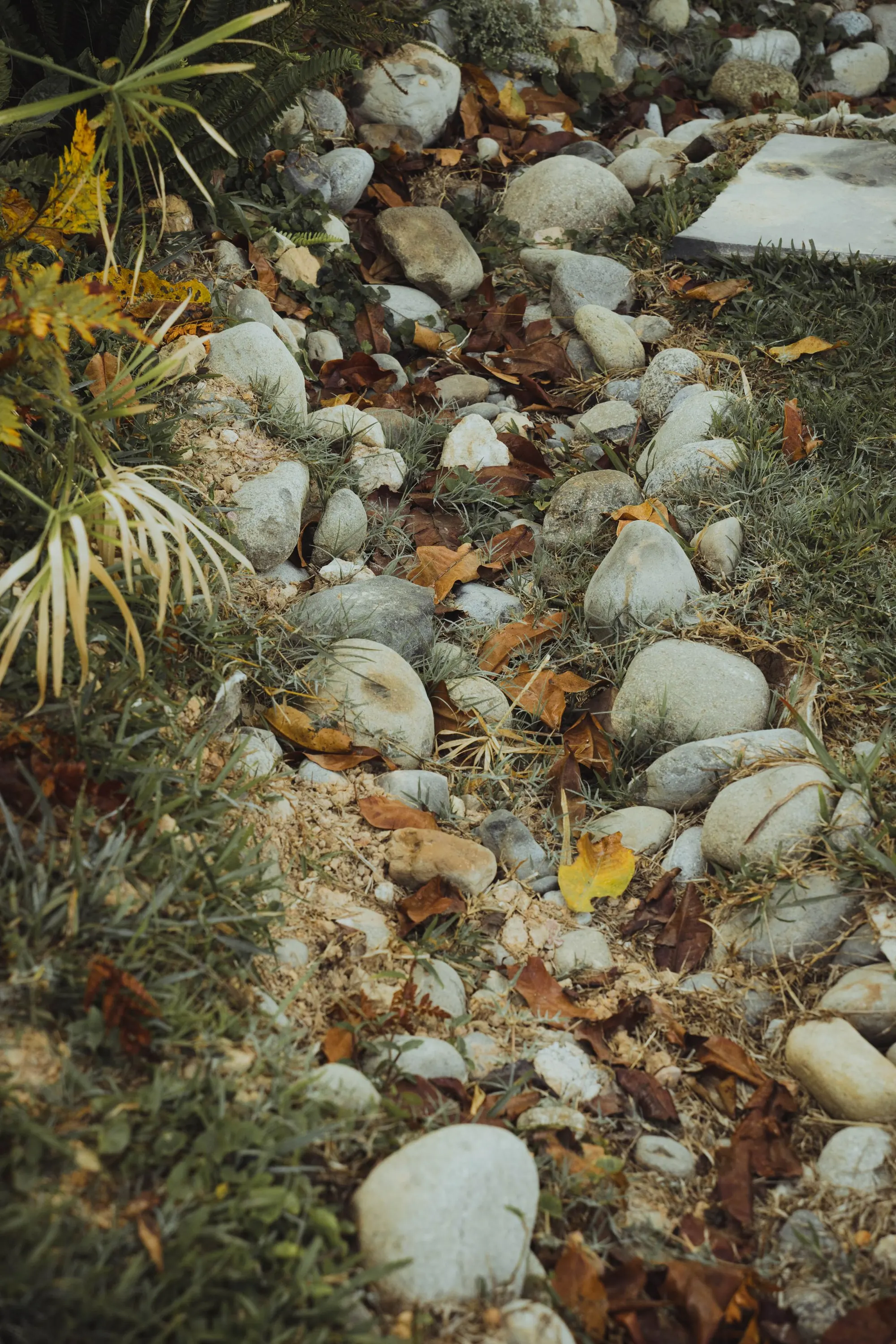
Swales and dry creek beds. A shallow channel shaped into the yard, lined with stone, carries surface water to a better place and can look like a garden feature rather than a ditch.
French drains. A trench with perforated pipe wrapped in stone and fabric that collects water below the surface and moves it to a discharge point. They suit places where water collects or seeps and surface fixes will not reach. See drainage and french drains.

What can go wrong with a drainage job
The most common mistake is a drain that has nowhere to go. A pipe that ends in the middle of the yard just moves the puddle. Another is skipping the filter fabric or using the wrong stone, so the drain clogs with clay silt. A third is solving water in one yard by sending it to the neighbor's, which is both unfair and often restricted. Confirm any rules about discharge with your city or county and your HOA, since they vary.
Roots, buried utilities and irrigation lines also complicate digging. Always have underground utilities located before anyone digs, which is usually done through the free 811 locating service. Ask your contractor how they handle it.
Where the water should end up
Every fix needs an outlet. Good places include a street gutter or storm drain where local rules allow it, a lower part of your own yard with room to spread and soak in, a rain garden planted with moisture-loving species, or a pop-up emitter at the end of a buried pipe. Bad places are the neighbor's lot, a septic field, or the base of your own foundation.
A rain garden is worth a note. It is a shallow planted basin that holds runoff for a short time while it soaks in, and it can turn a wet corner into a feature. It works best when the clay is loosened and amended, and when overflow has a path to leave. Planting and bed design can build one into a larger plan.
When to call a pro
Simple jobs like extending a downspout or adding mulch to a low bed are fine to do yourself. Call someone when water reaches the foundation or crawl space, when the same area floods repeatedly, when the slope is steep, or when you are not sure where the water is coming from. A pro will walk the property during or just after rain, check the grade and look at the whole flow, not just the wet spot.
If your landscape plan is changing too, it helps to solve drainage first. A patio, retaining wall or new bed built on a wet spot will fail early.
What to do next
If you have a wet spot, take photos after the next rain and book a site walk. We will trace the water and explain the options. You can also read how lawns react to wet and dry seasons in our lawn care calendar, or see what shapes a proposal on the pricing page.
Questions people ask before the walk
How can I tell if water is coming from the roof or the ground?
Watch during a storm. If water spills from a gutter or downspout and pools at the same spot, the roof is the source. If it appears from uphill or seeps out of the soil, it is groundwater or surface runoff. Photos and a note of when it starts help a contractor figure out the cause.
Will a French drain fix a soggy lawn?
Sometimes. A French drain helps where water collects below the surface and has somewhere to go. If the real cause is flat grading, compacted soil or a downspout dumping nearby, other fixes may work better or be needed alongside it. A site visit is the way to find out.
Is standing water in my yard dangerous?
It can be a nuisance and a health issue. Standing water breeds mosquitoes and can drown turf and plants. Near the house it can push moisture into foundations and crawl spaces. If you see water pooling against the home, treat it as something to address soon.

Book a yard walk
Walk the yard with Luis.
A walk around the property with you, then a written proposal with the plan and the plant list.
Or call (704) 555-0163 · Mon-Fri 7:30am-5pm · Sat by appointment