

Crane-assisted tree removal
Some trees don't have anywhere to fall. A crane picks the whole section off the stem and sets it in the street instead — no rigging line, no swing, no plywood prayer under a roofline.
When a crane is the right call
Most of our removals come down the ordinary way: a climber, a rope, and a controlled lower to the ground. A crane changes that math when the ordinary way runs out of room or margin. Four situations bring it up:
- No drop zone. A tight lot in Dilworth or Plaza Midwood where the canopy overhangs three property lines and there's no clear ground to lower a piece into.
- Dead or hollow wood. A tree Wes won't put a climber's spikes into because the wood won't hold weight. If we can't trust the stem, we don't climb it — we pick it apart from the outside instead.
- Over a pool or a slate roof. Sectional rigging still swings a piece before the rope catches it. A slate roof or a pool deck doesn't forgive a swing. A crane lifts straight up and straight over.
- Tight urban lots. Older Charlotte neighborhoods were platted before anyone thought about tree removal — narrow side yards, shared driveways, a neighbor's fence six feet from the trunk. A crane works from the street and never touches the ground in between.
None of this is the default. Most Charlotte lots have somewhere reasonable to drop wood, and most trees are sound enough to climb — the ordinary rigged takedown is still how the majority of our removals happen. A crane gets proposed when the site visit turns up one of the four situations above, not as an upsell on a tree that would come down fine the normal way.
How a pick actually works
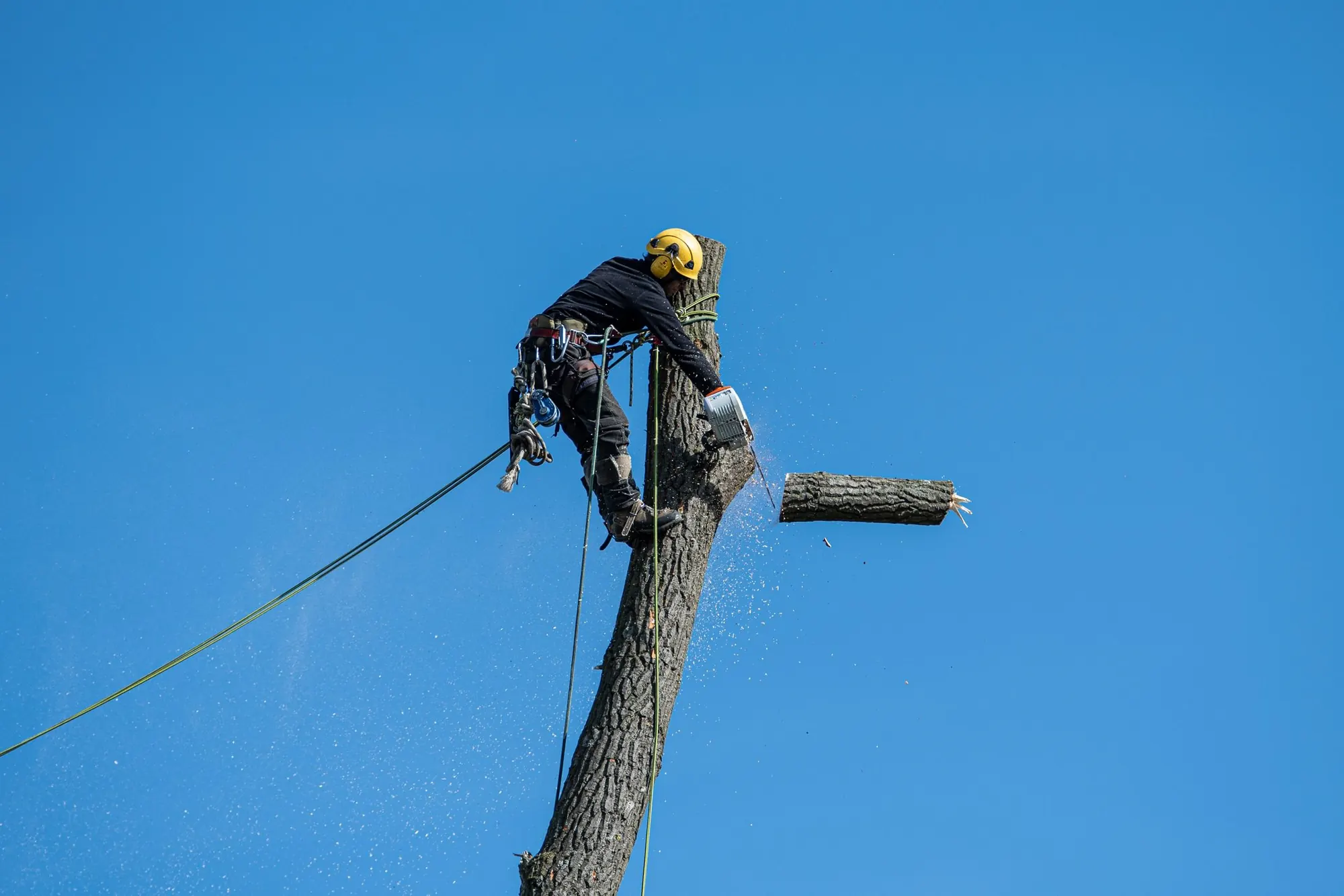
The climber still goes up — a crane doesn't replace the climber, it replaces the rigging line. Wes ties in, cuts the section free at the top and bottom of the cut, and the crane's headache ball takes the load instead of a rope and a groundie's muscle. The operator lifts the whole piece — branches, leaves, and all — up and over the house or the pool, and sets it down in the street or a driveway where a second crew member bucks it up with a saw. A big willow oak might come down in six or eight picks instead of forty small rigged drops. That's the entire advantage: fewer, bigger, cleaner moves instead of many small risky ones.
The crane operator and Wes talk through the pick sequence before the first cut — which section comes off first, where each one lands, and what the load weighs, since the operator has to know that before the boom ever swings a piece over a roofline. Nothing gets picked until both of them agree it's ready.
Street closure and permits
Setting a crane usually means parking outrigger pads across part or all of a residential street, which means a short closure while we work. For most Charlotte neighborhoods that's a courtesy — a cone, a flagger if traffic's heavy, done in a day. Depending on the street and the county, a permit may be required before the crane shows up; we handle that paperwork as part of booking the job, not something you have to chase down yourself. We also knock on the neighbors' doors the day before. Nobody likes a 60-foot crane arm swinging past their kitchen window without warning. On a corner lot or a wider street we can sometimes set up without closing anything at all — that gets worked out on the site visit once we know where the crane needs to sit relative to the tree.
Cost reality
A crane isn't cheap to bring in, and we don't pretend otherwise.
| Factor | Without crane | With crane |
|---|---|---|
| Crew time on a hard, no-drop-zone tree | 2 full days, sectional rigging every piece | Often a half day |
| Added cost | — | a written flat-rate number per day, operator and rig |
| Risk to structures underneath | Lower but not zero — rigging still swings | Lowest — load travels straight up and over |
Here's the part that surprises people: a crane often costs about the same as the extra day of hand-rigged labor it replaces, or close to it. A hollow 70-ft oak that would take a two-man crew two full days to rig down piece by piece can come down in half a day with a crane on site. You're not always paying a written flat-rate number on top of the removal price — sometimes you're trading a day of rigging labor for a day of crane rental. We'll run both numbers on the quote so you can see which one actually costs more for your specific tree. What doesn't change either way is the written flat-rate quote — crane or no crane, you get one number before we cut, good for 60 days, and it's the number on the invoice.
Safety
The same rule applies whether a crane is on site or not: nothing free-falls over a structure. Every piece is either roped down by hand or set down by the crane under control — never dropped and never guessed at. Wes stays tied in for the entire pick sequence, same as any other job; the crane doesn't change who's making the cutting decisions 60 feet up, it changes what happens to the wood after the cut. We coordinate directly with the crane operator and the ground crew on radios so nobody's under a load that's moving.
Ask about it on your quote
You don't need to know whether your tree needs a crane before you call — that's part of what the site visit tells us. Run the basics through the Job Sizer first, or call and we'll take a look and tell you straight whether it's a crane job or a climb.
Questions about this
How do I know if my tree needs a crane?
You usually don't need to guess — we'll tell you on the site visit. The giveaways are no safe place to drop wood, a trunk that's dead or hollow, or a canopy directly over a roof, pool, or a neighbor's property with no rigging room.
Does a crane make the job faster or just safer?
Both, on the right tree. A hard, no-drop-zone removal that would take a crew two days of sectional rigging can often come down in half a day with a crane, since each pick moves a whole section instead of dozens of small pieces.
Will a crane damage my lawn or driveway?
The crane itself usually stays on the street or a driveway, set on outrigger pads that spread its weight out over a wide area instead of a few points. We put plywood under the pads on request, especially over decorative pavers, older concrete, or a driveway you don't want marked.
Do you own the crane or rent it?
We rent it, operator included. Cranes are specialized equipment that need their own certified operator, insurance, and setup crew, and we bring one in only for the specific jobs that call for it instead of carrying that overhead into every quote we write.
Can a crane reach a backyard tree from the street?
Often yes — cranes can reach well past the street and over a house with the boom fully extended, which is usually the whole reason they get used instead of bringing heavy equipment through a narrow side yard. Exact reach and overhead clearance get checked on the site visit before we quote it.
Get a written number, on the spot.
Free on-site quote, usually within 48 hours. The number we write is the number you pay.