

Frequently asked questions
Straight answers to what people ask before they call: pricing, insurance, permits, and what happens when a storm drops a limb on the driveway. If your question isn't here, call and ask it directly.
Most of what people want to know before they call falls into a few buckets: what it costs, whether we're legit, what actually happens on cutting day, and what happens when a storm gets there first. Answers are grouped below. If yours isn't here, the storm line and the regular line both go to a person, not a menu.
Pricing & quotes
How much does tree removal cost?
It depends on height, whether the tree is over a structure, and how the wood has to come down, piece by piece or as a whole tree. Most Charlotte removals land between a written flat-rate number. A small tree under 30 feet with clear access can run under a thousand; a towering pine over 75 feet with a house underneath can run several thousand. For the full breakdown by height and complication, see the cost page, or run your job through the Job Sizer for a range in three taps.
Why won't you give me a price over the phone?
We won't quote a firm number without seeing the tree. Too much of the cost hinges on things a phone call can't show us: root flare against a slab, how a lean sits over the roof line, whether the trunk is hollow. What we'll give you over the phone, or through the Job Sizer, is an honest range. The firm, flat-rate number comes after Wes or another arborist walks the property, and it's good for 60 days once it's written down.
Do I need a permit to remove a tree?
Usually not, if the tree is in your own yard. Charlotte's tree ordinance mostly governs the right-of-way, the strip between the sidewalk and the street, and commercial or multifamily lots, not a homeowner's back yard willow oak. If your tree sits in the right-of-way, backs up to a protected buffer, or the job is commercial, we'll tell you during the estimate whether a permit applies and help you sort it before the crew shows up.
Do you charge more for nights, weekends, or holidays?
No. Nights, weekends and hurricanes cost the same as a Tuesday, and that includes the storm line. We don't add an after-hours surcharge for emergency work, and we don't pad a quote because it's a Saturday. The number on your written estimate is the number on your invoice, regardless of when the crew actually shows up to do the work.
Safety & insurance
Are you insured?
Yes. Highline carries 2 million in general liability coverage, and every crew member is covered by workers' comp, not just the groundies, the climber too. We'll email a certificate of insurance before the crew arrives if you or your HOA wants one on file. Ask for it when you book; it takes us a few minutes to send.
What happens if your crew damages something on my property?
It's covered by our liability policy, and we tell you before it becomes a bigger problem, not after. If a limb clips a gutter or a chip lands somewhere it shouldn't, we say so on site and make it right. That's separate from the Clean-Yard Guarantee, which covers debris we miss: find any within 48 hours and we're back the same day, stump grind or a written flat-rate number off included.
What if the tree is on or near a power line?
If it's touching a line on the utility side of the meter, that's Duke Energy's line to clear, not ours. We'll tell you to call them first, and we can often coordinate timing so our removal follows their line work. If the tree is near your own service line to the house, or a line on your side of the meter, we handle it, working de-energized when we can and treating every line as live until we've confirmed otherwise.
Do you work with HOAs or handle commercial contracts?
Yes. We send certificates of insurance to management companies routinely, work from HOA-approved vendor lists in several Charlotte-area communities, and handle commercial lots and multifamily properties on standing contracts as well as one-off jobs. If your HOA requires a specific bid format or a board walk-through before work starts, tell us during scheduling and we'll build it into the timeline.
The work itself
Do you climb, or use a bucket truck?
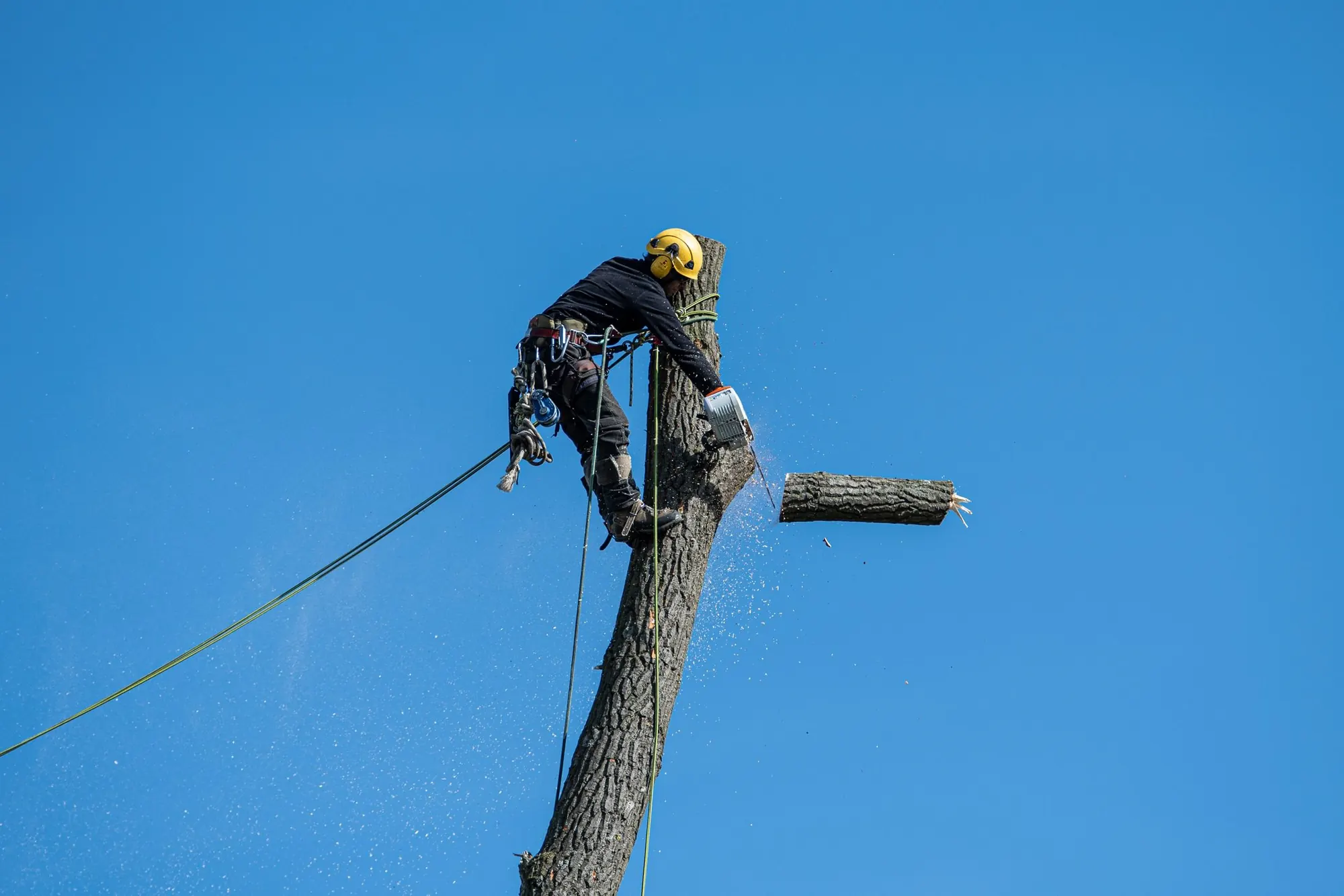
Both, depending on the tree and the job. A bucket truck is faster when there's clear access and open ground to park on. A climber goes up on rope, the highline, when the truck can't reach, when the canopy is too tight, or when sectional lowering over a structure calls for someone making cuts from inside the tree. Wes still climbs; he doesn't send a crew to a tree he wouldn't go up himself.
What happens to the wood after removal?
Standard removal price includes hauling the wood off-site. We don't leave a pile of rounds in the driveway unless you ask us to. Large trunk sections sometimes get set aside for firewood if you want to keep them; say so before we start cutting. Everything else, brush, branches, and rounds you don't want, goes through the chipper or onto the truck and leaves with the crew.
Can I keep the mulch or wood chips?
Yes. Whatever comes out of the chipper is yours if you want it, dump it in a pile by the garden beds, spread it along a fence line, whatever's useful. Tell us where before the crew starts running branches through the chipper, since it's a lot easier to aim the chute once than to move a wet pile of chips across the yard afterward.
Do you top trees?
No. Topping, cutting a tree back to stubs to reduce its size, ruins the structure and usually shortens its life instead of helping it. It leaves weak, fast-growing regrowth that's more likely to fail in the next storm, not less. If a tree has gotten too big for where it's planted, the honest options are selective reduction pruning by an arborist or removal, and we'll tell you straight which one actually fixes the problem.
What's the best time of year to prune?
Late winter, while the tree is still dormant and bare, is the best window for structural pruning on most of Charlotte's oaks and maples. You can see the branch structure clearly and the cuts heal fast once spring growth starts. That said, dead, damaged, or hazardous limbs get removed whenever we find them, any season. Storm damage doesn't wait for the right month, and neither do we.
Storm damage
How far out are you booked, especially after a storm?
Routine pruning and removal typically books out one to three weeks, longer right after a major storm moves through the region. Storm work runs on a different clock entirely. The 15-minute callback and 4-hour on-site window on the storm line hold regardless of how backed up routine scheduling gets, because that line is staffed and prioritized separately from the regular calendar.
Do you work with insurance adjusters for storm damage claims?
Yes. We document damage with photos before we touch anything, itemize the work on the invoice the way adjusters expect to see it, and we're glad to walk a claims adjuster through what came down and what it took to clear it. If your policy requires a specific format or a separate written estimate for the claim, tell us and we'll provide it alongside the standard invoice.
What areas do you cover for storm response?
Mecklenburg County gets the 4-hour on-site guarantee. We also run storm calls into Union, Cabarrus, and south Iredell counties, Matthews, Mint Hill, Huntersville, Cornelius, Concord, Waxhaw, and the towns around them, though response time outside Mecklenburg depends on how spread out the calls are that day. Call the storm line either way; we'll tell you honestly how soon we can get there.
Questions about this
How much does tree removal cost in Charlotte?
Most jobs run a written flat-rate number depending on height, access, and whether the tree is over a structure. A small tree under 30 feet can come in under a thousand; a towering pine over a house can run several thousand. Run your job through the Job Sizer for a free range, or see the full cost breakdown by height on our pricing page.
Why won't you give a price over the phone?
Too much of the cost depends on things a phone call can't show us, like root flare against a foundation or whether the trunk is hollow. We'll give you an honest range over the phone or through the Job Sizer. The firm, flat-rate number comes after an arborist walks the property, and it's good for 60 days once written down.
Are you insured?
Yes. Highline carries 2 million in general liability coverage, and every crew member, climber included, is covered by workers' comp. We'll email a certificate of insurance before the crew arrives if you or your HOA wants one on file. Just ask when you book.
What if the tree is on or near a power line?
If it's touching a line on the utility side of the meter, that's Duke Energy's to clear first, and we'll tell you to call them. If it's near your own service line, we handle it, working de-energized when we can and treating every line as live until confirmed otherwise.
Do you work with insurance adjusters after storm damage?
Yes. We photograph the damage before we touch anything and itemize the work on the invoice the way adjusters expect to see it. We're glad to walk a claims adjuster through what came down and what it took to clear it, and can provide a separate written estimate if your policy requires one.
Get a written number, on the spot.
Free on-site quote, usually within 48 hours. The number we write is the number you pay.